how to say you in korean informal Informal thank
Today, I want to share with you some interesting tidbits about the Korean language. Learning a new language can be both exciting and challenging, and in this case, we will delve into how to say “Thank You” in Korean. So, if you ever find yourself in South Korea or interacting with Korean speakers, these simple yet meaningful words will definitely come in handy.
How to Say Thank You in Korean
Let’s begin with the formal way of expressing gratitude in Korean. When you want to express your thanks in a more polite and respectful manner, you can say “감사합니다” which is pronounced as “kamsahamnida.” Remember, Koreans pay special attention to respect and hierarchy, so using this phrase is appropriate when speaking to someone older or of higher status.
 On the other hand, if you are in a more casual or friendly setting, there is a different way to say “Thank You” in Korean. In this case, you can use the phrase “고마워” which is pronounced as “gomawo.” This informal expression of gratitude is commonly used among friends, peers, or even family members. It is a way to show appreciation in a less formal manner.
 Learning these two different ways of saying “Thank You” in Korean is a great way to showcase your appreciation and respect for the Korean culture. By using the appropriate phrase in the right context, you can build stronger connections and show your sincere gratitude.
Now, let’s take a moment to talk about how fascinating the Korean language is. Korean is a member of the isolated Koreanic language family and is the official language of South Korea and North Korea. It is also spoken by Korean communities worldwide.
The Korean writing system, known as Hangul, is unique and has been recognized as one of the most scientific and efficient writing systems in the world. It was created during the 15th century by King Sejong the Great and a group of scholars who aimed to make literacy more accessible to the Korean people.
Hangul is an alphabet system comprising of 14 basic consonants and 10 basic vowels, resulting in a total of 24 letters. The combination of these letters allows for the creation of syllables, making it easy to read and write Korean once you grasp the basics.
Not only are the written characters fascinating, but the spoken language itself possesses its own charm. The Korean language is known for its unique pitch accent system. This means that the pitch or tone of your voice can change the meaning of a word or phrase. It adds a melodious quality to the language and makes it all the more intriguing.
Lastly, I want to leave you with this thought: learning how to say “Thank You” in Korean is not only a gesture of politeness but also a gateway to understanding and appreciating the rich Korean culture. So, next time you have the opportunity to express your gratitude in Korean, remember to use the right phrase depending on the situation. Happy learning!
If you are looking for Formal and Informal Words in Korean | Korean language, Learn korean you’ve came to the right page. We have 5 Images about Formal and Informal Words in Korean | Korean language, Learn korean like Formal and Informal Words in Korean | Korean language, Learn korean, Thank You In Korean Informal Way and also How to Say Thank You in Korean | Korean language, Learn korean alphabet. Here it is:
Formal And Informal Words In Korean | Korean Language, Learn Korean
 www.pinterest.comformal coreano hangul speak domandhyo idioma slang sentence hyo koreanisches vocabulario vocabulary bahasa formales koreanisch basicas abecedario writing koreanische 에서
How To Say “I” And “Me” In Korean In Both Informal And Formal
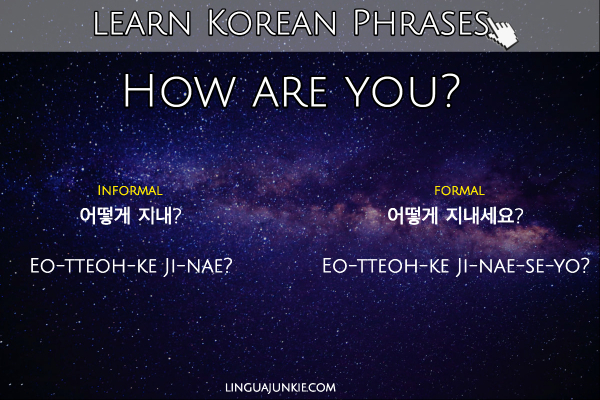
 www.youtube.comHow To Say “How Are You?” In Korean And How To Answer - LearnKorean24
 learnkorean24.comThank You In Korean Informal Way
thankyoucardwedding.blogspot.cominformal thank
How To Say Thank You In Korean | Korean Language, Learn Korean Alphabet
www.pinterest.com.mxkorean domandhyo koreanische koreanisch vocabulary sprache worte hyo informal koreanisches grammatik südkorea sprachenlernen wörter danke infographics
Formal coreano hangul speak domandhyo idioma slang sentence hyo koreanisches vocabulario vocabulary bahasa formales koreanisch basicas abecedario writing koreanische 에서. How to say thank you in korean. Informal thank